the comparison
Palantir vs Traditional Consulting
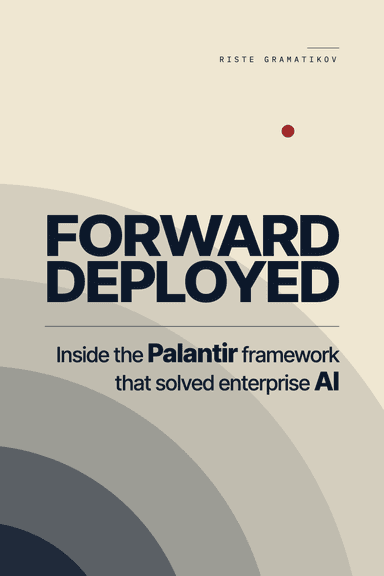
From the book
Forward Deployed is the book on Palantir vs traditional consulting — how the Forward Deployed Engineer model beats recommendations and staff augmentation with a compound learning engine.
Buy on Amazon →When an enterprise decides to transform its operations with AI, the default move is to hire a consulting firm. McKinsey for strategy. Accenture or Deloitte for implementation. Maybe both. The engagement follows a familiar arc: discovery workshops, requirements documents, phased rollouts, and a handoff to an internal team that wasn't involved in building the system.
Palantir does something structurally different. Instead of sending consultants who advise, Palantir embeds Forward Deployed Engineers who build. The distinction isn't semantic — it creates fundamentally different outcomes.
The Handoff Problem
Traditional consulting fragments ownership across specialists. A strategy team defines the vision. A systems integrator builds the architecture. Data engineers handle pipelines. DevOps manages deployment. A support team maintains the result. Each handoff creates translation loss — the people building the system never experienced the original problem, and the people who defined the problem never see how it actually gets implemented.
Palantir eliminates handoffs entirely. A Forward Deployed Engineer embeds inside the customer environment, diagnoses the real problem (not the stated one), builds the solution, deploys it into production, and iterates based on real operational feedback. One person. End-to-end. The person who hears “we need a dashboard” is the same person who discovers the real need is a supply chain early warning system — and builds it.
Recommendations vs Production Systems
McKinsey's output is a recommendation. A slide deck. A framework. The client pays for intellectual clarity about what should happen. But the gap between “what should happen” and “what actually works in production” is where most enterprise transformations die.
Accenture's output is a built system — but built by teams who rotate across projects, working from requirements documents rather than embedded understanding. The system works to spec. Whether it works for the actual operational problem is a different question.
Palantir's output is a production system that works under real constraints — built by someone who experienced those constraints firsthand. FDEs apply root cause analysis (Fault Tree Analysis, the 5 Whys) before writing code, ensuring they solve the right problem. The methodology comes from reliability engineering, not management consulting.
Linear Cost vs Compound Learning
This is the structural difference that matters most.
Consulting is a linear cost model. Every new engagement starts from scratch. The consultants who worked on your supply chain project last year are now at a different client. Their knowledge left with them. Next year, you pay again for discovery, again for implementation, again for the learning curve.
Palantir's model compounds. Every FDE engagement contributes patterns, integrations, and templates back to Foundry. The work that one FDE did connecting SAP to a MES system at a manufacturing client becomes a reusable pipeline for the next manufacturing client. Manual integrations that required weeks eventually become automated capabilities that take hours.
After hundreds of deployments across defense, healthcare, energy, manufacturing, and finance, Palantir's platform has accumulated institutional knowledge that no consulting firm can replicate — because consulting firms don't have a platform that learns.
The Talent Model
Consulting firms optimize for utilization — keeping billable bodies on seats. This creates a structural incentive to extend engagements and maintain dependency. The business model rewards the client not becoming self-sufficient.
Palantir's FDE model optimizes for deployment velocity. FDEs are measured on how quickly they can get a customer to production value, then move to the next problem. The platform handles sustainability — once a workflow is built in Foundry, the customer operates it. The FDE moves on.
The talent selection is also fundamentally different. FDEs are hired for learning agility and problem decomposition — the ability to walk into an unfamiliar domain and become dangerous quickly. Consulting firms hire for domain expertise and client management. These are different cognitive profiles optimized for different outcomes.
When Each Model Makes Sense
Traditional consulting works when you need strategic clarity, organizational change management, or regulatory navigation — problems where the output is a decision or a process, not a production system.
Palantir's model works when the problem requires integrating messy real-world data, building operational systems that humans use under pressure, and creating capability that compounds over time. Manufacturing quality control. Supply chain visibility. Clinical trial optimization. Counter-terrorism analysis. Problems where the gap between “strategy” and “production” is where value is created or destroyed.
The question isn't which is “better” — it's which problem you actually have.
Forward Deployed shows the FDE model working under real pressure — the full MidWest Manufacturing case study follows both the Forward Deployed Engineer and Deployment Strategist solving a production crisis. It is the book on why the model beats traditional consulting.