the business model
How Palantir Makes Money
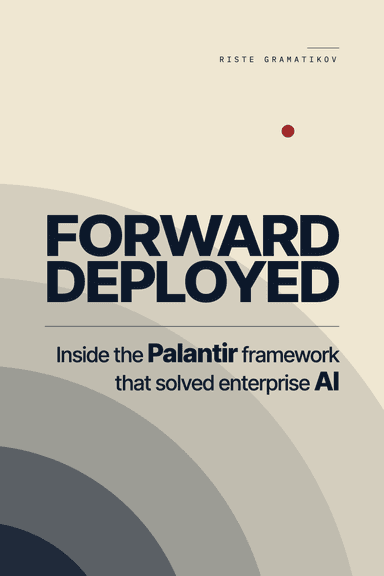
From the book
Forward Deployed is the book on how Palantir makes money — the land-expand-compound model, the Ontology, and the Forward Deployed Engineer flywheel that makes the economics compound.
Buy on Amazon →Palantir's business model is one of the most misunderstood in enterprise software. It's not SaaS in the traditional sense — there's no self-service signup and per-seat pricing. It's not consulting — there are no billable hours. It's not licensing — customers don't buy a product and install it. Understanding what it actually is explains why the revenue metrics look the way they do.
The Land-Expand-Compound Cycle
Palantir's revenue engine operates in three phases, each building on the last.
Land. A new customer engagement typically starts with a specific operational problem — a manufacturing quality crisis, a supply chain visibility gap, a clinical trial bottleneck. Palantir deploys a Forward Deployed Engineer who embeds inside the customer environment and builds a working solution on Foundry, usually within weeks. The initial contract covers this first use case.
Expand. Here's where the model diverges from traditional enterprise software. To solve that first use case, the FDE maps the customer's data into the Ontology — creating a semantic layer of business objects (vehicles, parts, suppliers, patients, transactions). That Ontology doesn't just serve one use case. It becomes the foundation for every subsequent use case.
A manufacturer who started with quality monitoring discovers that the same Ontology objects — vehicles, parts, suppliers, batches — can power supply chain optimization, predictive maintenance, and compliance reporting. Each new use case requires incremental work (not a from-scratch build) because the data integration and semantic mapping already exist. More use cases means more users, more compute, more revenue — without a new sales cycle.
Compound. Each deployment contributes patterns, integrations, and templates back to the platform. The work an FDE did connecting SAP to a MES system at one manufacturer becomes a reusable capability for the next. Manual integrations that took weeks become automated capabilities that take hours. The platform gets smarter with every customer, making each subsequent deployment faster and more profitable.
Revenue Mechanics
Palantir charges through a combination of software subscription fees and usage-based pricing . Customers pay for access to the platform (Foundry, AIP) and for the compute, storage, and usage they consume. As customers build more use cases on the Ontology, their usage — and their spending — grows organically.
This is why Palantir's net dollar retention consistently exceeds 115-120% . Existing customers spend significantly more each year, not because of price increases, but because they're building more on the platform. The Ontology creates a natural expansion path that doesn't require aggressive upselling — the architecture itself drives adoption.
The AIP Bootcamp model has accelerated this further. Instead of months-long sales cycles, Palantir now takes prospective customers from zero to a working use case in days. The bootcamp demonstrates value so quickly that the traditional objection — “we need to evaluate this for six months” — dissolves. Customers see production value before the contract is even signed.
Why It's Not Consulting
The most common misunderstanding is that Palantir is “just consulting with software.” The confusion comes from the FDE model — embedding engineers inside customer environments looks like consulting from the outside. But the economics are structurally different.
Consulting revenue is linear. Every dollar requires a human billing hours. Growth means hiring more consultants. Margins are structurally capped by utilization rates.
Palantir's revenue compounds. The FDE builds on a software platform that stays after they leave. Each deployment makes the platform smarter. The same FDE who took 12 weeks to solve a problem at their first deployment can solve a similar problem in 3 weeks at their tenth — because the platform accumulated the patterns. Revenue scales with software usage, not headcount.
This is visible in the gross margins. Consulting firms operate at 30-40% gross margins. Palantir's gross margins are consistently above 80% — the signature of a software business, not a services business.
The Two Segments
Palantir reports revenue in two segments: Government andCommercial . Both run on the same platform (Foundry/AIP) and use the same deployment model (FDEs). The difference is the customer, not the technology.
Government was first — Palantir was built for intelligence agencies. This segment provides stable, long-term contract revenue with high switching costs. Commercial is where the growth is — manufacturing, healthcare, energy, finance. The commercial segment has been growing significantly faster as AIP and the bootcamp model accelerate customer acquisition.
What most analysts miss is that the two segments compound each other. Patterns learned in government deployments (handling classified data, multi-source integration, operating under extreme security constraints) transfer to commercial deployments. And commercial deployments (connecting ERP systems, automating workflows, building operational applications) feed capabilities back that make government deployments better.
What Drives Future Growth
Three structural forces drive Palantir's revenue trajectory:
Ontology depth. As customers map more of their operations into the Ontology, each incremental use case becomes cheaper to build and more valuable to the customer. The marginal cost of the twentieth use case is a fraction of the first.
AIP acceleration. AIP lets customers build applications and automations faster — what took weeks with manual development now takes days with AI-assisted code generation within Foundry's guardrails. Faster building means faster expansion means faster revenue growth.
Platform compounding. Every deployment makes every future deployment faster. This is the flywheel that traditional enterprise software companies don't have — their products don't learn from deployments. Palantir's does.
Forward Deployed maps each layer of the system that creates these economics — from the Ontology to the FDE model to the compound learning flywheel. It is the book on how Palantir actually makes money.