Free Chapter
ORGANIZATIONAL IMPLEMENTATION
Chapter 3 — Structure That Dampens Rivalry
When brilliant engineers join traditional enterprise software companies, something predictable happens: they build the same solutions their competitors build. Different companies, different people, identical architectures. Even exceptional talent trapped in conventional organizational patterns tends to converge on conventional solutions. Palantir's approach starts from recognizing that culture creates structure, not the other way around—and that anti-mimetic principles must be embedded in the very architecture of how teams form, operate, and evolve.
No Titles, No Hierarchy
Palantir implements what most organizations consider radical: everyone has essentially the same title. When Nabeel Qureshi worked there, “everyone had the ‘forward deployed engineer’ title, more or less, and apart from that there were five or six Directors and the CEO.” This traces directly to Peter Thiel's application of Girardian theory: if you create titles, people start desiring them, creating competitive politics that undermines internal unity.
Influence comes from accomplishment, not position. As Qureshi describes: “Some people were more influential than others, but the influence was usually based on some impressive accomplishment, and most importantly nobody could tell anyone else what to do.”
This creates what Shyam Sankar calls “decoupling position and portfolio.” In traditional organizations, employees embody a defined position with a defined portfolio—predictable and legible, but inherently mercenary. Palantir's alternative treats position as an arbitrary construct: there are only people and their work. This fluidity allows the organization to reorganize around each problem, matching talent to challenges rather than forcing challenges into org chart boxes.
The cost is real: as Qureshi puts it, the company often feels like there's no clear strategy, more like “a Petri dish of smart people building their own projects.” People come in and out of influence quickly based on what they're working on and who they're working with—someone highly influential one quarter might be working on something less visible the next. But the generative capacity is extraordinary—novel UI concepts, infrastructure patterns, and deployment methodologies that competitors later spend years trying to replicate.
Mission-Autonomous Cells
This flat structure enables what Palantir calls “small, mission-autonomous cells”—teams of four to eight people organized around specific problems rather than functional expertise. One cell might form around supplier quality monitoring for an automotive manufacturer, combining an FDE who understands SAP integration, another who builds ML failure-prediction models, and a Deployment Strategist navigating the plant manager's resistance to automated holds on production. Another cell might tackle procurement fraud detection for the same customer, pulling in people with financial network analysis skills and ERP workflow experience. The cells form, deliver, and dissolve—the people recombine around the next problem. This isn't simply about team size; it's about creating environments where fewer direct status comparisons enable people to focus on outcomes rather than internal positioning. When everyone in a room can see the complete scope of a challenge, ownership becomes natural rather than negotiated.
The result is what Sankar describes as “quantum org structure”—simultaneously flat and hierarchical, functional and horizontal. For a point in time it manifests in an observed state when organized around the problem that needs solving right now, then reorganizes around the next problem with a different structure. People hate this because it seems chaotic, but the alternative—picking a structure and optimizing for legibility—inevitably stops working as soon as the world changes.
3.1 The Compound Learning Engine
At the heart of Palantir's organizational design lies a deceptively simple insight: the same people who understand customer problems most deeply should also have the most influence over platform development. This creates what they call the BD-PD symbiosis—a two-pronged engine where Business Development (Forward Deployed) teams gather context while Product Development teams build leverage.
The BD teams embed with customers in the messiest, most demanding environments—enduring constant travel, changing requirements, and operational fire drills to gain intricate knowledge of how complex organizations actually work. Meanwhile, PD teams focus on transforming the patterns BD discovers into scalable platform capabilities. This isn't a traditional handoff relationship; it's a continuous feedback loop where BD pain systematically becomes PD platform features.
The compound effect emerges over time. Each deployment benefits from existing capabilities while contributing new requirements. Platform capabilities didn't emerge from product roadmaps—they crystallized from repetitive manual work that BD teams encountered across hundreds of deployments. SDDI (Software-Defined Data Integration), the engine at the heart of Foundry's data layer, is the clearest example: thousands of manual data integrations performed by forward deployed teams—connecting SAP to MES, matching supplier portals to ERP systems, resolving the same table joins and column-naming problems across hundreds of customers—eventually became an automated system that proposes the right integrations, joins, and transformations before an FDE writes a single line of code.
The transformation from services to software became a defining shift for the company. What started as internal tools to help BD teams work faster became Palantir Foundry—the company's flagship data integration and decision automation platform.
The rest of this chapter focuses on the BD side of the engine — the Deployment Strategist and Forward Deployed Engineer roles — because that's where Palantir's organizational design diverges most sharply from convention. The PD function resembles product development at other strong engineering organizations. What makes it distinctive is the pipeline: PD engineers are typically successful FDEs who transition from field deployment to platform building, carrying with them an intimate understanding of real operational problems that no amount of product discovery research can replicate.
3.2 French Waiters: Professional Confidence in Practice
The BD-PD symbiosis depends on more than organizational structure—it requires a specific behavioral model that shapes how BD teams interact with customers. This model traces back to Alex Karp's direct observation of Parisian waiters. He noticed that French waiters approached their craft with a distinctive combination of presence, conviction, and authority—they shaped the dining experience rather than simply taking orders. When customers made requests that would diminish their experience, skilled waiters would redirect them toward better choices with professional confidence.
This became the template for what Palantir wanted from Forward Deployed roles. Too many enterprise engineers, Karp observed, behaved like deferential order-takers—building whatever customers requested without questioning whether those requests addressed the real problems. The French waiter model suggested a different approach: someone embedded in the flow of service, attentive to genuine needs, but confident enough to challenge assumptions and redirect energy toward what actually matters.
The BD (Forward Deployed) teams operate through two complementary roles that embody this model: Deployment Strategists focus on understanding the problem space, while Forward Deployed Engineers focus on building in the solution space. These roles blur heavily in practice. The sections that follow examine each role's methodology in detail.
3.3 The Deployment Strategist: Institutional User Research at Scale
The Deployment Strategist bridges the gap between Palantir's technology and a customer's urgent problems. Organizations come to Palantir suspecting that better use of their data could solve critical challenges, and the Deployment Strategist is responsible for turning that hunch into reality.
At most enterprise software companies, bridging this gap requires an army of specialists: business analysts to gather requirements, solutions architects to design systems, change management consultants to drive adoption, data scientists to build models, product strategists to prioritize features, and project managers to coordinate it all. Palantir consolidates these functions into a single role that applies user research methodology to institutional transformation.
The intellectual foundation for this role comes from Steve Portigal's book Interviewing Users, adapted for institutional rather than product contexts. Portigal's central thesis is that interviewing is a learned skill fundamentally different from everyday conversation—it requires deliberate techniques to uncover what users actually need rather than what they say they want. His core insight is that people's behavior reveals more than their stated preferences, and that truly understanding users means going beyond assumptions to directly engage with them in their natural environments.
Portigal's methodology centers on several key practices that Deployment Strategists apply daily. First, embracing the participant's worldview: suspending your own expertise and assumptions to truly hear what users are telling you. This means using their language, asking about their processes without presuming answers, and being curious about apparent contradictions rather than trying to resolve them. Second, open-ended questioning with strategic follow-up: starting with broad questions like “Can you walk me through how you typically...” and then probing deeper based on responses. The most valuable insights often come from unexpected directions, so the interviewer must remain attentive and follow interesting threads rather than rigidly following a script.
Third, and perhaps most valuable for institutional contexts, Portigal emphasizes contextual observation—watching users in their actual work environments rather than conference rooms. This reveals what he calls the gap between how organizations are supposed to work and how they actually work. Excel spreadsheets, Post-it notes, Slack channels, and email folders become evidence of where official processes fail. These workarounds tell stories that requirements documents never capture, revealing institutional knowledge trapped in human adaptations. When Deployment Strategists observe a quality engineer with six browser tabs open and printed cheat sheets taped to their monitor, they're seeing the real problem—not the sanitized version presented in stakeholder meetings.
The methodology's power lies in its ability to challenge internal assumptions and generate innovative solutions based on real user insights rather than organizational folklore. Portigal argues that interviewing not only provides data but builds empathy and can lead to reframing problems entirely. When someone asks for “faster dashboards,” the real need might be unified data access. When they request “better reporting,” they might actually need automated decision-making.
This is Principle 1—Reality as the Referee—in practice: Deployment Strategists anchor recommendations to observable evidence rather than organizational politics or stakeholder preferences. When reality conflicts with stated requirements, reality wins.
But user research is only part of what Deployment Strategists do. A typical day might begin with on-site meetings with client analysts, probing their key questions and pain points to identify where Palantir's platforms can have the most impact. From there, the DS works with Forward Deployed Engineers to integrate relevant data sources into stable pipelines—often performing hands-on data modeling themselves, writing Python or SQL code to transform data, then building custom workflows on top of Palantir's software.
Once solutions are built, Deployment Strategists lead training sessions with end users, acting as product expert and coach, teaching client teams how to use the tools and adjusting based on feedback. They present results and proposals to stakeholders at every level—from front-line analysts to C-suite executives—distilling complex analyses into persuasive insights and effectively becoming storytellers for the data solutions they implement.
Deployment Strategists also serve as the feedback loop to Palantir's engineering and product teams, relaying what they've seen in the field and suggesting improvements or new features. And they scope out new opportunities, building and delivering demos to potential customers and exploring how Palantir could solve problems in new industries or regions.
What remains constant across this breadth is outcome ownership: Deployment Strategists take accountability for delivering results, whether that involves configuring software, solving data problems, or rallying people to use the tools properly.
Palantir's requirements for Deployment Strategists emphasize analytical talent, technical skills, and flexibility rather than a specific degree or resume checkbox. There are “no defined paths to this role, no matching study backgrounds.” Instead, they look for candidates with exceptional problem-solving ability, creativity, and technical aptitude—people who can tackle open-ended problems in unstructured environments while demonstrating low ego and adaptive thinking. In practice, many come from quantitative fields (computer science, engineering, math, economics) or have experience in data-heavy roles.
3.4 The Forward Deployed Engineer: Building Under Pressure
If Deployment Strategists focus on understanding human systems, Forward Deployed Engineers focus on building technical systems that actually work under operational pressure. At most enterprise software companies, this work fragments across systems integrators, data engineers, software developers, DevOps specialists, and support teams. Palantir consolidates these functions into a single person with end-to-end ownership from problem identification to production deployment.
The intellectual foundation for this role draws from reliability engineering. FDEs learn to apply root cause analysis frameworks like Fault Tree Analysis and the 5 Whys—not as rigid mandates, but as disciplined thinking that prevents building solutions to the wrong problems.
Fault Tree Analysis was developed in 1962 at Bell Laboratories for the U.S. Air Force to evaluate the Minuteman I missile launch control system—a method for mapping all possible failure modes before building anything. The 5 Whys technique originated with Sakichi Toyoda and Taiichi Ohno at Toyota as part of the Toyota Production System, driving from symptoms to root causes through relentless questioning. Palantir combines these complementary techniques: Fault Tree Analysis maps the complete failure space, while 5 Whys drives deep into specific failure paths. This often reveals convergence points where multiple failure paths trace to the same root cause, showing exactly which structural problems need solving.
In practice, FDEs operate like startup CTOs for each customer's problem. A typical engagement begins with the Deployment Strategist's reframe of what the customer actually needs. From there, the FDE owns the complete technical stack—architecture decisions, data integration, custom development, and production deployment. Rather than reinventing data integration, access controls, or visualization frameworks for each deployment, FDEs leverage Palantir's platform as a ready-built toolkit, composing solutions from proven capabilities and adding custom logic only where the customer's unique problem demands it.
FDEs also serve as a crucial feedback loop to Palantir's product development teams. When field deployments reveal missing features or platform limitations, FDEs don't just work around them—they contribute code back to Palantir's codebase and drive product improvements from the front lines. Some of Palantir's most valuable platform capabilities originated from FDE contributions in the field, strengthening the BD-PD symbiosis that makes compound learning possible.
The methodology scales because it's reproducible. Any engineer trained in Fault Tree Analysis and 5 Whys can apply these techniques to new domains. Insights transfer across deployments, making each implementation faster than the last.
Forward Deployed Engineers come from varied technical backgrounds, united not by specific domain expertise but by their ability to rapidly learn new industries and apply disciplined problem-solving under pressure. What distinguishes them isn't depth in any single technical domain but rather T-shaped technical breadth—broad enough to own the complete stack, deep enough to build production systems.
3.5 The DS and FDE in Action: When Methodology Meets Crisis
The following case study of MidWest Manufacturing is a fictional composite based on real Palantir deployment patterns. While the company and individuals are fictional, the technical challenges, methodologies, and outcomes reflect actual enterprise transformation scenarios. This case study will continue throughout the book, demonstrating how organizational implementation (Chapter 3), Foundry's technical platform capabilities (Chapter 7), and AIP's AI-powered transformation (Chapter 8) work together to create transformational outcomes.
The call came at 6:47 AM on a Tuesday morning in March 2024. Sarah Chen, VP of Quality at MidWest Manufacturing, answered her phone to hear the words that every automotive executive dreads: three fatalities had been linked to brake component failures, potentially affecting 500,000 vehicles across multiple model years. The National Highway Traffic Safety Administration had given them 72 hours to provide root cause analysis or face federal investigation. The stakes couldn't be higher—$700 million in potential recall costs, the company's reputation, and regulatory action that could cripple their operations.
Traditional consulting approaches would fail before they started. The discovery phase alone for most enterprise engagements exceeds 72 hours, and quality traceability in automotive manufacturing involves dozens of systems, hundreds of suppliers, and millions of data points spanning years of production history. Sarah needed a different approach—one that could compress weeks of investigation into hours without sacrificing accuracy.
This is where Palantir's methodology proves its value. Rather than arriving with predetermined solutions or lengthy discovery processes, the Deployment Strategist and FDE brought complementary approaches: systematic questioning and systematic analysis, designed to work together under exactly these kinds of impossible constraints.
The DS's Discovery: Reading the Archaeological Evidence
The Deployment Strategist's first move wasn't to gather requirements or schedule stakeholder meetings—it was to ask Sarah's lead quality engineer to demonstrate the actual BC-2847 investigation—BC-2847 being the suspect brake component part number at the center of the recall—that had consumed four hours the previous week. What emerged was a masterclass in organizational archaeology, revealing the gap between official processes and operational reality.
The engineer's workspace told the story: three monitors displaying SAP QM, Excel lookup tables, and supplier portals simultaneously. Post-it notes with part numbers were taped to the monitor frame—a physical manifestation of information that should have been digital. The manual process required jumping between systems: SAP for quality records, Excel cross-reference tables for part number mapping, supplier portal logins for batch data, followed by email follow-ups when the 30% mismatch rate inevitably created dead ends.
But the real revelation came through artifact analysis—studying the tools people had created to work around system limitations. Six Excel spreadsheets mapped part numbers between systems. Printed cheat sheets showed supplier batch code formats. Email folders organized by supplier contained hundreds of threads asking for lot numbers. A Slack channel called #quality-data-help existed solely for crowdsourced data questions. Every artifact screamed the same message: there is no unified view of our supply chain.
The triangulation across organizational roles revealed how the same structural problem created different pain points for different people. Engineers spent 70% of their time finding data and only 30% analyzing it. IT received requests for “quick queries” that required weeks to build properly. The supplier quality manager couldn't force suppliers to standardize because they served multiple OEMs with different requirements. The CFO watched every hour of delay increase the potential recall scope and associated costs.
When Sarah requested “faster access to quality data,” she meant “make IT build dashboards faster.” But the Deployment Strategist heard something different: “we need to eliminate manual correlation entirely.” The reframe was direct: “Sarah, you don't have a speed problem. You have a unification problem. Your people have no unified view of the supply chain.”
The FDE's Discovery: Systematic Failure Analysis
While the Deployment Strategist mapped the human reality through observation, the FDE approached the same problem through systematic technical analysis. The Forward Deployed Engineer constructed a complete Fault Tree for quality traceability — mapping all possible failure modes before building anything:
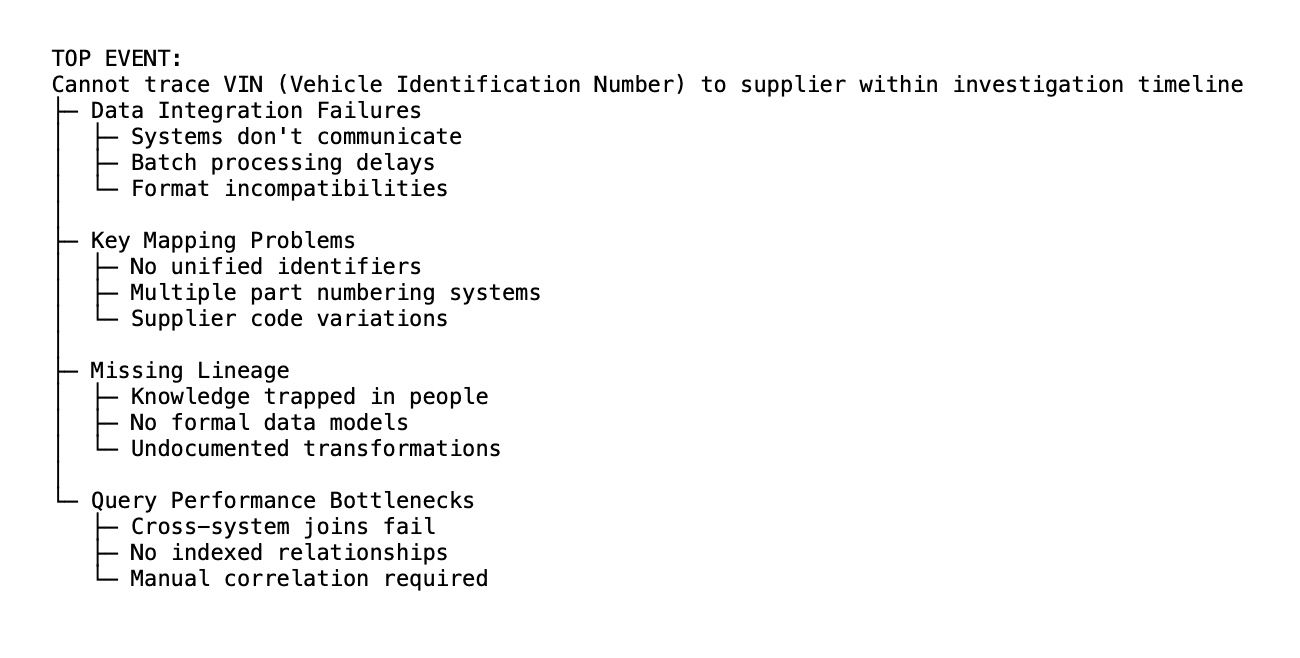
This revealed primary failure branches that observation alone might miss, each with cascading secondary failures that created the workflow pain the DS had observed.
The power of this approach became clear through 5 Whys analysis on each major failure mode:
Data Integration Failures:
1. Why can't systems communicate? → Disconnected architectures
2. Why disconnected architectures? → Point-to-point integrations
3. Why point-to-point integrations? → No integration platform
4. Why no integration platform? → No unified data strategy
5. Why no unified data strategy? → No semantic layer connecting entities
Key Mapping Failures:
1. Why can't we map part numbers? → No unified identifiers
2. Why no unified identifiers? → Systems evolved independently
3. Why did systems evolve independently? → No cross-system requirements
4. Why no cross-system requirements? → No platform approach
5. Why no platform approach? → No semantic layer unifying disparate identifiers
Missing Lineage:
1. Why is lineage missing? → Knowledge trapped in people's heads
2. Why trapped in people? → No formal documentation
3. Why no formal documentation? → No data models
4. Why no data models? → No systematic approach
5. Why no systematic approach? → No semantic layer defining relationships
The convergence discovery was striking: all three failure modes traced to the same systemic issue. This wasn't a speed problem—the individual systems were actually quite fast. It wasn't a data problem—the data existed in the source systems. The actual problem was the absence of a unified semantic model connecting entities across systems—a shared map that knows, for example, that SAP part number “BRK-2847-A,” supplier batch code “LOT-7741,” and MES assembly record “ASM-2024-03-1147” all refer to the same physical brake component sitting in the same vehicle. Each system had its own language for the same real-world objects. Without a translation layer that understood these relationships, the only way to connect them was a human being with six Excel spreadsheets and a lot of patience.
The FDE's validation confirmed the DS's reframe while adding technical precision: “The Deployment Strategist is right about unification. My systematic analysis confirms that all failure modes trace to a missing semantic layer. But Fault Tree Analysis reveals six different ways this manifests, not just the workflow pain observed through user research.”
The Convergence: When Methodologies Align
The power of the DS-FDE partnership became clear in how they translated the same insight for different audiences. The DS provided the business case—“Here's what your people actually need and why”—while the FDE provided the technical solution—“Here's the systematic way to build what they need.” The same unified data model became “a single source of truth for your supply chain” when the DS spoke to Sarah, “semantic layer with entity relationships” when the FDE spoke to IT, and “turn 4-hour investigations into 30-second lookups” when the DS spoke to the CFO.
The impossible math that forced innovation was stark: 4 hours per investigation multiplied by 100+ suspect failures required 300-400 hours of work, but they had only 72 hours total with 8 quality engineers. The math simply didn't work, forcing a radical reframe from “faster investigations” to “eliminate investigations entirely.”
The Solution: Building the Unified Semantic Layer
With 48 hours remaining, the DS and FDE moved from analysis to implementation. While the Deployment Strategist continued stakeholder management—coordinating with IT for system access, briefing Sarah on progress, and preparing the regulatory narrative—the FDE began constructing what would become MidWest's unified quality traceability platform.
The integration challenge was immense. MidWest's quality data was scattered across three disconnected systems: SAP Quality Management for defects and inspections with cryptic German table names, Manufacturing Execution System (MES) for production assembly records linking VINs (Vehicle Identification Numbers — the unique serial number stamped on every car) to components, and Supplier Portal containing batch process parameters and quality certificates. Each system used different identifiers, data formats, and update schedules, creating the manual correlation nightmare that consumed 70% of engineers' time.
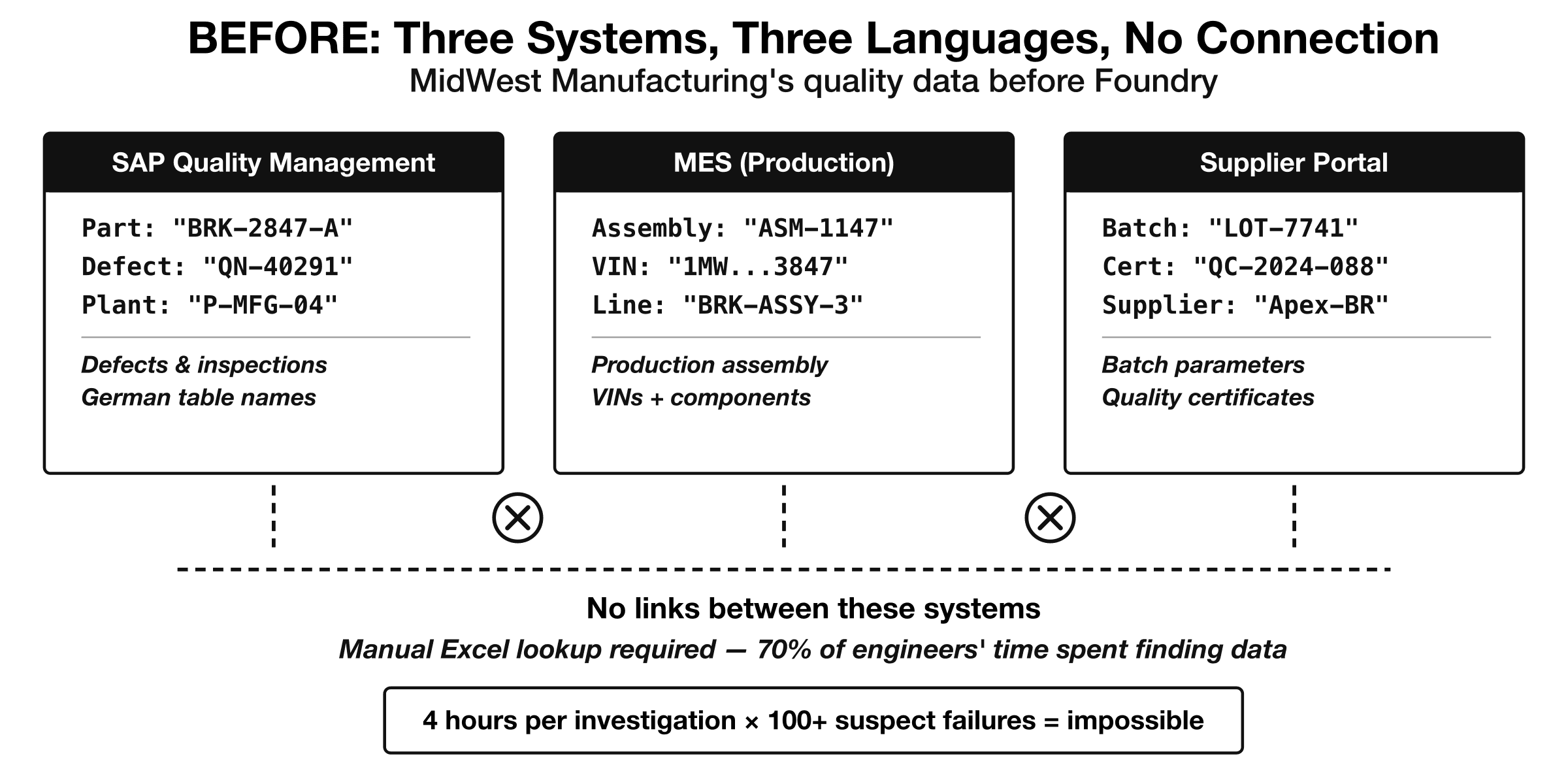
To understand what the FDE built, picture MidWest's data problem as three filing cabinets in three different buildings, each using its own labeling system. The FDE's job was to build a single unified data model inside Foundry — a semantic layer that pulls from all three systems and represents the entire supply chain in one place, using one language. Here's how it happened, step by step:
Step 1: Connect the data sources. Using Foundry's built-in connectors, the FDE piped data from all three systems into a single environment. SAP's quality records, the MES production logs, and the supplier portal's batch certificates — all flowing into one place. This took hours rather than the weeks a custom integration would normally require, because Foundry already had connectors for SAP and standard MES formats.
Step 2: Build the translation dictionary. This is where the DS's field research paid off. Remember the six Excel spreadsheets taped to the quality engineer's monitor? Those spreadsheets contained the tribal knowledge of how identifiers actually mapped in practice — which SAP part numbers corresponded to which supplier batch codes, including all the exceptions and edge cases that no official documentation captured. The FDE used these as the Rosetta Stone, encoding the translation rules into Foundry: “BRK-2847-A” in SAP = “LOT-7741” at the supplier = assembly record “ASM-1147” on the production line.
Step 3: Map the chain of relationships. With the translations in place, the FDE defined how entities relate to each other in the real world: a VIN identifies a vehicle → that vehicle was built on a specific assembly line → that assembly used specific components → those components came from specific suppliers → those suppliers produced them in specific batches → those batches have quality test records. Each link in this chain connects data that previously lived in separate systems.
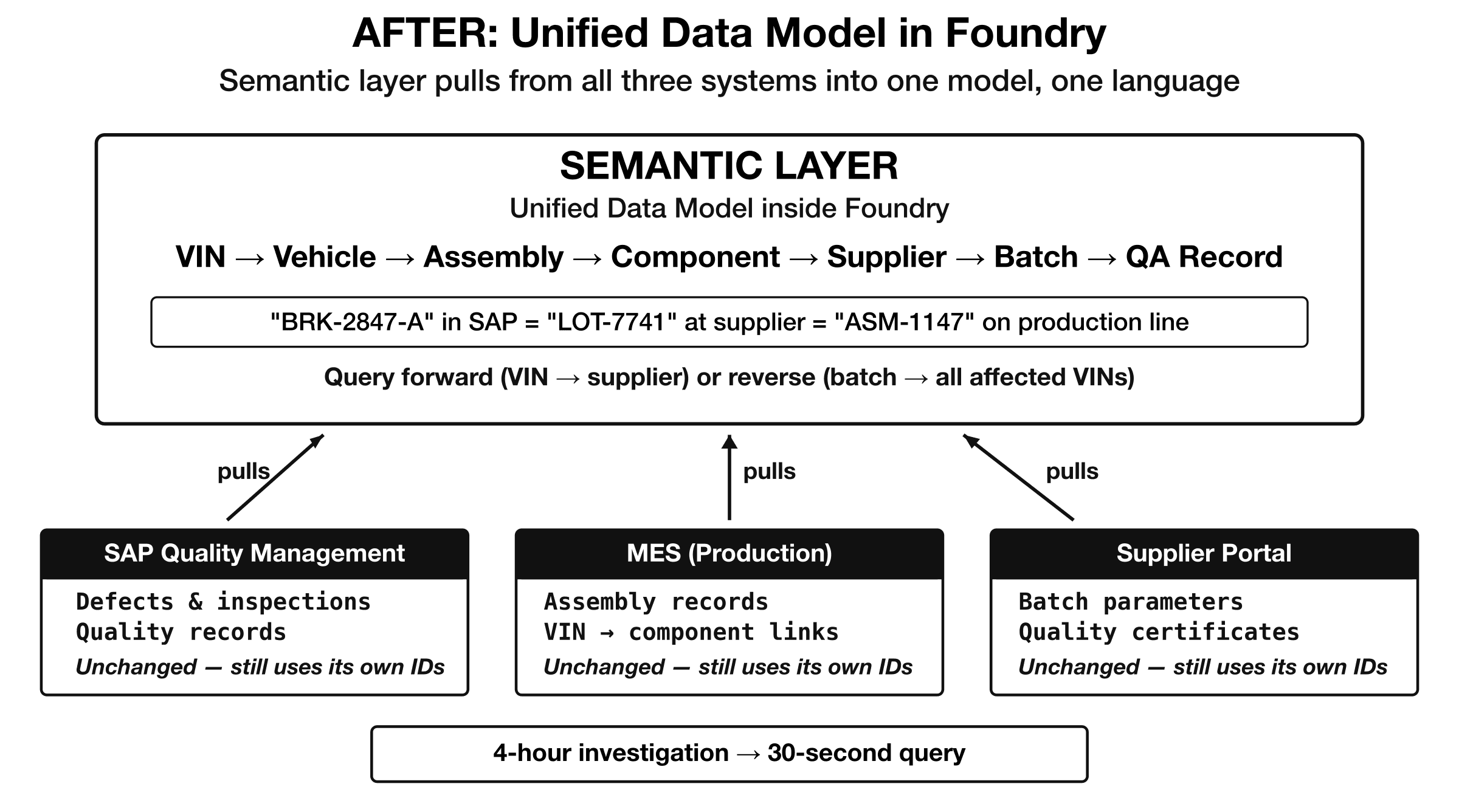
Step 4: Make it queryable. The final step was building the interface that quality engineers would actually use. Type in a VIN, and the semantic layer follows the chain: vehicle → assembly → component → supplier → batch → quality records. Type in a suspect batch number, and it runs the chain in reverse: batch → supplier → component → assembly → vehicle → every affected VIN. The 4-hour manual investigation became a 30-second query.
The entire build took roughly 40 hours — possible only because Foundry provided the connectors, the data transformation engine, and the modeling tools out of the box. What would typically require a team of integration specialists, data engineers, and database administrators was accomplished by a single Forward Deployed Engineer working with Foundry's platform.
The Outcome: From Crisis to Capability
By hour 60, the system was operational. What had taken 4 hours of manual correlation now happened in seconds through automated queries. The quality engineers could type a VIN and immediately see the complete supply chain lineage: which supplier provided which component, what batch it came from, what quality tests were performed, and when. More importantly, they could run the analysis in reverse—starting with a suspect component and instantly identifying all affected vehicles.
The brake component investigation that triggered the crisis was completed in 6 hours instead of the projected 300+. The root cause was traced to a single supplier batch where a furnace temperature deviation had produced a metallurgy defect—affecting 47,000 vehicles instead of the feared 500,000. The targeted recall saved MidWest an estimated $400 million while demonstrating to regulators that they had systematic control over their supply chain quality.
But the real transformation went beyond crisis response. The unified semantic layer became the foundation for predictive quality analytics, supplier performance monitoring, and automated compliance reporting—capabilities that will be detailed in Chapter 7. What started as an emergency response became a competitive advantage that fundamentally changed how MidWest managed quality across their entire operation.
Sarah's reflection six months later captured the broader impact: “We thought we needed faster dashboards. What we got was a completely different way of thinking about our data. Now when we have a quality issue, we don't investigate—we already know.”
The MidWest case demonstrates why both roles are essential: understanding people requires empathy and observation, while understanding systems requires systematic analysis and logical decomposition. The Deployment Strategist discovers what people actually do versus what processes say they should do, while the FDE maps what systems actually do versus what architecture says they should do. When both methodologies converge on the same architectural insight—as they did in 72 hours at MidWest—implementation becomes execution rather than exploration. The technical platform that made that speed possible — Foundry's integration architecture, the semantic layer in detail, and the advanced capabilities that turned MidWest's emergency response into a competitive advantage — is the subject of Chapter 7.